
Sortation
Unbox Robotics Manifesto: Why Sortation Needs a Reset
April 06, 2026
Sortation has not significantly changed in three decades.
Yes, the hardware has gotten faster. The belts move quicker. The scanners read more barcodes per second. But the underlying logic, the way a sortation system thinks about a parcel and decides where it goes, is still largely the same as it was when e-commerce was a footnote.
That is the problem nobody in intralogistics wants to say out loud.
The system was built for a world that no longer exists
Traditional sortation was designed around predictability. Fixed volumes, consistent SKU profiles & shipping destinations that did not change week to week. The engineering assumption was simple: if you know what is coming in, you can build a fixed path for it to travel out.
That assumption collapsed somewhere around 2015, and it has been unravelling faster ever since.
Today, a mid-size warehouse automation for e-commerce operation running 50,000 parcels a day during off-peak might be handling 180,000 during a sale weekend. Reverse logistics flows have grown to the point where some retailers process returns equal to 30% of their outbound volume. Last-mile carriers are multiplying. Parcel sorting automation for courier companies is no longer optional at these volumes. Destination profiles change every quarter.
The building you designed for Tuesday in March was not built for the Saturday before a major sale event. But the sortation system inside it does not know the difference.

What it actually costs when sortation fails
Sortation errors are not just operational annoyances. They are revenue events.
A misdirected parcel in a last mile sortation automation context costs, on average, between 3x and 5x the original cost to sort it correctly. It has to be retrieved, re-scanned, re-routed, and in many cases re-packaged. If it misses a dispatch window, the cost compounds again. A carrier like DHL handling automated parcel handling for the courier and parcel industry at scale cannot afford a sortation accuracy rate of 98%. That 2% error margin, at millions of parcels daily, is a logistics crisis wearing the clothes of an acceptable statistic.
The issue is not that operators do not care about accuracy. It is that the systems they are running were not built to maintain accuracy when conditions drift from the original design spec.
Why the fix is not more hardware
The instinct when sortation breaks down is to add more infrastructure. Another sorter line. An additional induction station. More chutes. Most operators looking at alternatives to conveyor belt sorting systems still end up buying a variation of the same thing.
This works, up to a point. And then you hit a ceiling that no amount of steel can solve.
The real constraint in conventional sortation is not throughput. It is intelligence. A conveyor belt cannot look at a parcel and decide, based on current conditions across the entire facility, the optimal path for that specific item at that specific moment. It follows the rule it was programmed to follow at installation. That rule does not update itself when a carrier goes offline, when a chute backs up, or when a flash promotion doubles the volume of a particular destination zone in 45 minutes.
The bottleneck is not the belt. It is the logic baked into it. That is what makes AI-powered warehouse sortation solutions fundamentally different, not faster hardware, but software that can actually think.
What a reset actually looks like
Unbox Robotics was built around a different starting point.
Instead of asking "how do we move parcels faster through a fixed path," the question was: "what if the path itself was a variable?"
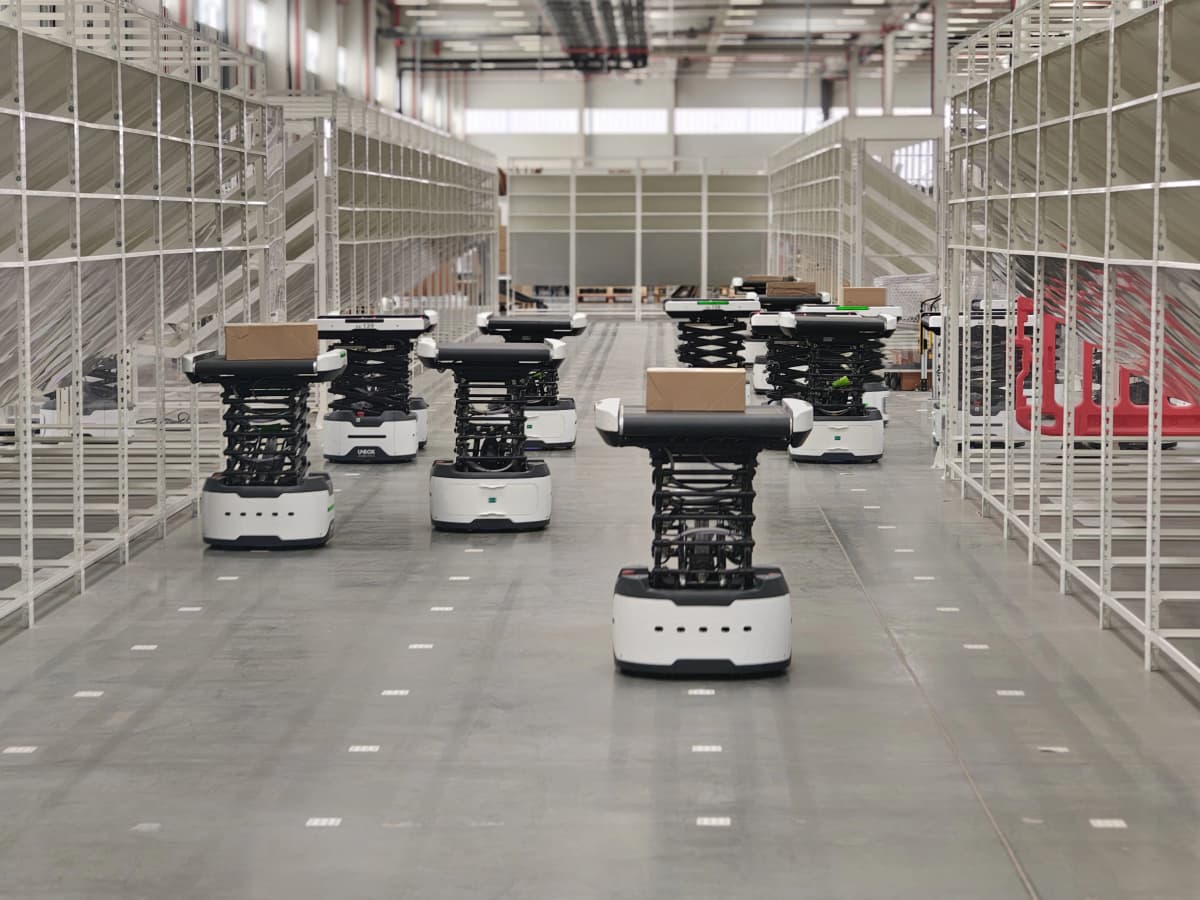
The UnboxSort robotic sortation system puts the sortation logic into software, not steel. A fleet of warehouse sortation robots moves across the floor, each one making real-time decisions guided by a central intelligence layer that tracks every parcel, every destination, every constraint, and every change across the facility simultaneously.
When a carrier's dispatch window shifts by 20 minutes, the system knows. When a chute reaches capacity, the fleet re-routes without stopping. When volume spikes 3x at 11am, the software recalibrates across the entire fleet, not one machine at a time.
This is what swarm intelligence means in practice. Not robots doing clever things in isolation. A fleet thinking together. It is also what separates the best robotic sortation system from a faster version of the same old infrastructure.

The 100% accuracy argument
The number that surprises people most when they first look at UnboxSort is the sort accuracy figure: 100%.
Not 99.7%. Not "best in class." 100%.
That is not a marketing position. It is a system outcome made possible by the way the intelligence layer works. Every parcel is tracked from induction to discharge. Every route decision is validated in real time. There is no moment in the flow where a parcel is handed off to a static system that cannot react to what is happening around it.
The operators running UnboxSort, including GXO, Trendyol, DHL, and Inditex, chose this because they could not afford the alternative. These are operations spanning e-commerce fulfillment, sort center automation, and 3PL warehouse automation at genuine scale. At the volumes they process, a fraction of a percentage point in accuracy error is measured in tens of thousands of misdirected parcels per month. UnboxSort also handles automated returns sortation within the same system, so the accuracy standard applies to reverse flows too, not just outbound.
The vertical dimension is underused, almost everywhere
Here is something most sortation vendors do not lead with: your ceiling is wasted space.
Conventional sortation is horizontal by design. It spreads across the floor because the machinery requires it. The result is that operators expanding throughput capacity are also expanding their footprint, which means more square footage, more lease cost, and often a move to a larger facility.
UnboxSort sorts in three dimensions. Integrated vertical mobility means the fleet can use height as an active sortation variable, not just a storage dimension. For fulfillment centres in high-cost urban locations, this is not a nice-to-have. It is a meaningful shift in how you calculate the cost per parcel across a facility's lifespan.
Modular deployment is not a compromise. That is the point.
One of the quieter arguments against warehouse automation is the implementation cost, not just the capital cost, but the operational disruption of getting from current state to future state.
A full conveyor replacement in an active fulfillment centre can mean weeks of reduced throughput, months of integration work, and a go-live that carries real risk. Operators have been burned by this before.
UnboxSort is modular by design, and that matters for two reasons.
First, you can start with a portion of your sortation workflow and expand from there. The system does not require a full facility overhaul to deliver value. Second, it integrates with existing WMS environments through standard interfaces, which means you are not rebuilding your software stack to accommodate new hardware.
Customers are seeing positive ROI as compared to legacy systems. Not because the sales deck says they will, but because the system adds capacity to live operations without replacing what already works.
What this means for the next three years
Fulfillment is not getting simpler.
Returns volumes are climbing across every retail segment. Same-day and next-day delivery expectations are expanding beyond the major urban centres into secondary cities. Mid-mile networks are being rebuilt from scratch by carriers who have outgrown their existing infrastructure.
Each of these trends puts more pressure on sortation. More parcels. More destinations. More variability. More moments where a fixed system hits its ceiling.
The operators who will handle that pressure most effectively are not the ones with the fastest conveyors. They are the ones whose sortation systems can think fast enough to keep up.
Unbox Robotics recently closed a Series B round to accelerate global expansion, deepen its R&D work, and extend UnboxSort into additional warehouse workflows. The investment reflects a simple conviction: the next decade of fulfillment will be defined less by how much infrastructure you have, and more by how intelligently it behaves.
The reset has already started
GXO, DHL, Trendyol, Inditex. These are not pilot customers testing a hypothesis.
They are global operations running UnboxSort at production scale, across geographies, across fulfillment models, and across the kind of demand variability that exposes the limits of conventional sortation every single week.
The reset is not a future event you are preparing for. It is already happening in the facilities of the operators who decided that the old model was not worth defending.
The question for anyone running a fulfillment or distribution operation today is straightforward: Is your sortation system built for the volume and variability you are running now, or for the operation you had when it was installed?
If it is the latter, it is worth having a different conversation.
