
Sortation
Physical AI Has Reached the Warehouse Floor: What It Means for Parcel Sortation in 2026
September 07, 2026
By Satya Swaroop Beegala, Associate Director - System & Product
If you spent any time online in early 2026, you heard the phrase. At CES in January, NVIDIA's Jensen Huang called it the "ChatGPT moment for physical AI" and declared that every industrial company is about to become a robotics company. That's a big claim, and honestly my first reaction was to roll my eyes a little. We've all sat through enough hype cycles. But the more time I've spent on warehouse floors this year, the more I think this one is real. So let me cut through the noise and talk about what physical AI actually means for the least glamorous, most important part of the building: sortation.
So what is Physical AI, really?
Strip away the marketing and it's simple. Physical AI refers to AI systems that can perceive, reason about, and act within the physical world. In robotics, that means combining sensing, intelligence, and physical action so machines can respond to changing real-world conditions rather than relying entirely on fixed instructions. Software AI powers the chatbots, recommendation engines, and fraud-detection models running quietly in the background. Physical AI is what lets a self-driving car brake for a cyclist, or a warehouse robot grip an odd-shaped parcel and drop it in the right chute.
The reason this matters is adaptability. Traditional warehouse automation is tuned around a defined operating envelope. Push it well beyond that, with a very different process or hand it a new package size or a changed floor layout, or a big step-change in volume, and adapting it takes real engineering time. Physical AI systems absorb more of that change on their own, which is why analysts describe them as compressing what used to be year-long automation projects into months.
Why it's suddenly everywhere
Two things happened at once. The technology got good enough to work outside a lab, and the money followed. The physical AI market is projected to grow from around $1.5 billion in 2026 to more than $15 billion by 2032, a compound growth rate of roughly 47%. And warehousing is not a side use case here, it's the main event. When people look for the clearest real-world example of physical AI in production, they point at logistics and warehouse automation, because that's where the problems are structured enough to solve and valuable enough to be worth solving.
India is right in the middle of this shift. According to Entrackr, startups in the Indian physical AI ecosystem raised around $155 million across 31 deals in 2026 so far, up sharply on prior years. Supply chain robotics is leading the way: Unbox Robotics was among the biggest raises of the year at $28 million, led by ICICI Venture, one of a small group of companies that companies together accounted for more than half of that total. When investors put real money into supply chain physical AI, it's usually because it is already working on the floor.
And you can see it working. Amazon's Sequoia system, which brings together mobile robots, gantries, and robotic arms, lets the company store inventory up to 75% faster and cut order processing time by up to 25%. That's not a demo. That's a fulfillment center shipping your order faster because the machines got smarter.
Not all physical AI looks the same
It's worth being clear about what physical AI looks like in practice today, because the term covers a lot of ground. The version already paying for itself in warehouses is purpose-built: fleets of task-specific robots engineered to do one job extremely well and to keep doing it reliably at scale. In a distribution center, one of the highest-value jobs for that focused physical AI is sortation, because it sits right before dispatch and directly shapes how fast orders get out the door.
But there is a part of physical AI nobody puts in a keynote. Most of the conversation happens at the top of the stack, the perception models, world models, and reasoning that demo well. None of it survives contact with a real warehouse floor unless the layer underneath it is solid: the motor drivers, the sensing hardware, and the controllers that actually move a robot and stop it safely when something goes wrong.
That foundation is what decides whether a fleet of robots can share a floor with people. A robot that can reason about a cluttered aisle is only useful if its safety architecture can guarantee it stops in time, every time, to the certification level regulators expect: IEC 61508, ISO 3691-4, and the SIL and PL ratings that go with them. That is not software polish. It is base-level engineering: safety-rated motor drivers, dual-channel E-stop architectures, and controllers built to a formal requirements and hazard-analysis process from day one.
That is the layer we have been quietly building at Unbox: safety-grade AGV controllers, dual-axis motor drivers, and safety controllers engineered to these standards rather than bolted on afterward. It is unglamorous work, and it is the reason a fleet of robots can move quickly around people on a real floor instead of only in a simulation. Physical AI's ceiling is not set by how smart the model is. It is set by how much you can trust the hardware underneath it.
What this actually means for parcel sortation
This is where it comes together for sortation. Sorting parcels is a live, constantly changing problem, and it is exactly the kind of real-world task physical AI is built for.
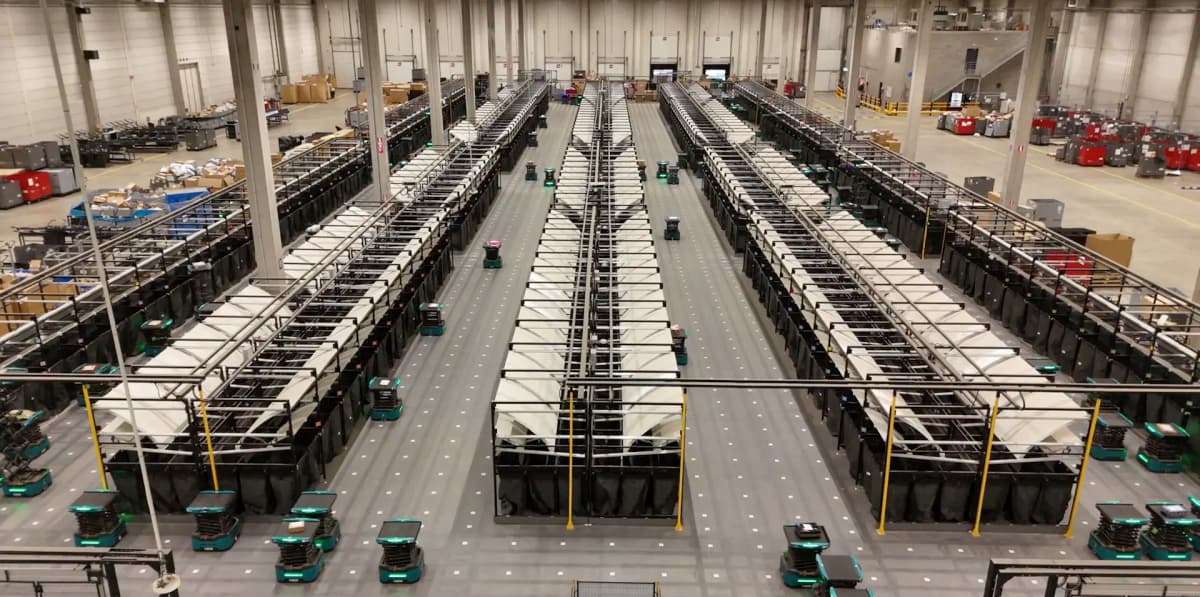
UnboxSort demonstrates a practical form of physical intelligence in sortation: a coordinated fleet of robots that continuously makes routing and traffic decisions while physically moving parcels through the operation. The coordination happens at the system level, keeping the whole floor optimized in real time rather than leaving each robot to fend for itself. That is how UnboxSort sorts and consolidates several times more parcels in the same footprint than a manual line, adapts when volume spikes, and reconfigures in software rather than steel. It drops into your existing four walls and scales by adding robots, which is the whole point of physical AI: intelligence that flexes with the work instead of forcing the work to fit the machine.
So when someone asks what physical AI means for their operation, my answer is usually the same. It looks like your sortation floor suddenly keeping up with peak without a rebuild.
What to do about it in 2026
You don't need to bet the business on a moonshot. The practical move is to adopt physical AI where it already pays back, and sortation is the obvious starting point because it sits at the pinch point right before dispatch. Look for systems that adapt to changing parcels and volumes, coordinate as a fleet, and scale without ripping out your floor. Focus on the practical machines that quietly ship more orders today.
The phrase "physical AI" will fade into normal language soon enough, the way "the cloud" did. What stays is the shift underneath it: warehouses that think and adapt in real time. If you want to see what that looks like on a real sortation floor, talk to the team at Unbox Robotics, or take a look at the operations already running on it. The ChatGPT moment for the warehouse isn't coming. On the sortation floor, it's already here.
FAQ
What is physical AI?
Physical AI is artificial intelligence that perceives, reasons about, and acts in the physical world, taking into account real-world physics like friction and momentum. Unlike software AI that generates text or images, physical AI powers robots that move and manipulate objects.
How is physical AI used in warehouses?
It powers robots that adapt to changing conditions, such as new package sizes, shifting layouts, and volume spikes, without being reprogrammed each time. Parcel sortation, picking, and inventory handling are among the clearest production use cases.
Does physical AI need new hardware, or just smarter software?
Both, but hardware comes first. Perception and decision-making models get the attention, but they only matter if the underlying motor drivers, controllers, and sensors meet the safety certifications (IEC 61508, ISO 3691-4) needed to operate a robot around people reliably. That base-level safety engineering is what makes fleets of physical AI robots deployable at scale, not just in a lab.
Where does physical AI deliver value in a warehouse today?
In purpose-built, task-specific systems that do one high-value job reliably at scale. Parcel sortation is a leading example, because it sits right before dispatch and directly affects how quickly orders ship.
How does physical AI apply to parcel sortation?
Sortation is a physics-heavy, constantly changing task, which suits physical AI well. Swarm-intelligence systems like UnboxSort coordinate a fleet of robots in real time to sort and consolidate parcels, adapt to volume, and scale by adding units.