
Automation
Peak Season Doesn't Create Problems. It Exposes Them
August 21, 2026
Five lessons I've learned from talking to warehouse operators across Europe.
Every August, I start having the same conversations.
Warehouse operators ask me how they can prepare for the upcoming peak season. Most expect we'll spend the next hour talking about robots, throughput, or the latest automation technology.
Ironically, we rarely do.
Instead, we talk about the decisions they made six or twelve months earlier.
Because here's the reality:
Peak season doesn't create problems. It simply exposes the ones that have been hiding in your operation all year.
The warehouses that perform best in November aren't necessarily the ones with the newest technology. They're the ones that prepared early enough to challenge their existing processes before the pressure arrived.
After speaking with logistics operators across Europe, these are the five lessons I see repeated over and over again.
1. If you're planning for this year's peak, you're already too late
One of the biggest misconceptions I encounter is timing.
Many companies start looking at automation in late summer, hoping to have a system operational before Black Friday. On paper, it sounds reasonable. In reality, it's one of the biggest mistakes you can make.
A successful automation project isn't complete when the hardware is installed. That's when the real work begins.
Operators need training. Software integrations need refinement. Layouts get adjusted. Edge cases appear that nobody anticipated during the design phase.
Every deployment teaches you something.
You want those lessons in July—not in November.
If you're serious about improving your peak season logistics, don't plan your implementation around peak. Plan to have the system fully stabilised months before it starts.
If you're reading this in August, don't think about this year's peak. Start planning for next year's.
2. Don't automate your manual process. Redesign it.
This is probably the biggest mindset shift I wish more companies would make.
Many warehouses approach automation with a simple objective:
"How do we do exactly what we do today - but automatically?"
That's the wrong question.
Automation is an opportunity to rethink the entire process.
I've seen operations where products are sorted multiple times because that's how the manual workflow evolved over the years. Items are consolidated, moved, sorted again, transferred to another area, and finally sorted again before dispatch.
Every additional touch costs time, labour, space and money.
Instead of asking how to automate your current workflow, ask yourself:
If we were designing this warehouse from scratch today, would we still build it this way?
Very often, the answer is no.
The best automation projects don't simply replace manual work.
They eliminate unnecessary process steps altogether.
3. Stop thinking about picking and sorting as separate processes
One thing I've noticed is that warehouses often optimise these two processes independently.
Picking teams focus on maximising pick rates.
Sortation teams focus on moving parcels as quickly as possible.
But the biggest improvements happen when both processes are designed together.
A well-designed picking process can dramatically simplify sortation.
Likewise, the right sortation technology can reduce the complexity of picking and packing.
I also challenge another common assumption.
Many operators believe labour savings happen primarily in picking, while sorting can remain manual.
In reality, modern sortation can eliminate a surprising amount of manual handling, especially if it removes multiple sorting stages or allows orders to be sorted directly to their final destination.
One of my favourite questions during customer discussions is simple:
Why sort three times if you can sort once?
Every additional touch introduces cost, complexity and another opportunity for errors.
4. Don't buy throughput. Buy flexibility.
When discussing new automation projects, customers often ask for maximum throughput or the highest possible number of destinations.
Interestingly, that's not always what they actually need.
I've seen customers request 1,500 destinations only to discover that today's operation only requires 500.
Sometimes they still choose the larger system.
And that's perfectly reasonable.
Future-proofing can be a smart investment.
The important thing is understanding why you're investing in additional capacity - not simply assuming that bigger is always better.
The same applies to warehouse layouts.
More and more customers ask whether a solution can be relocated if the network changes or production moves to another site.
Five years ago, flexibility was rarely part of the discussion.
Today, it's often one of the deciding factors.
Warehouse networks evolve much faster than automation equipment.
Your automation should evolve with them.
5. Space is becoming more valuable than throughput
One project has stayed with me.
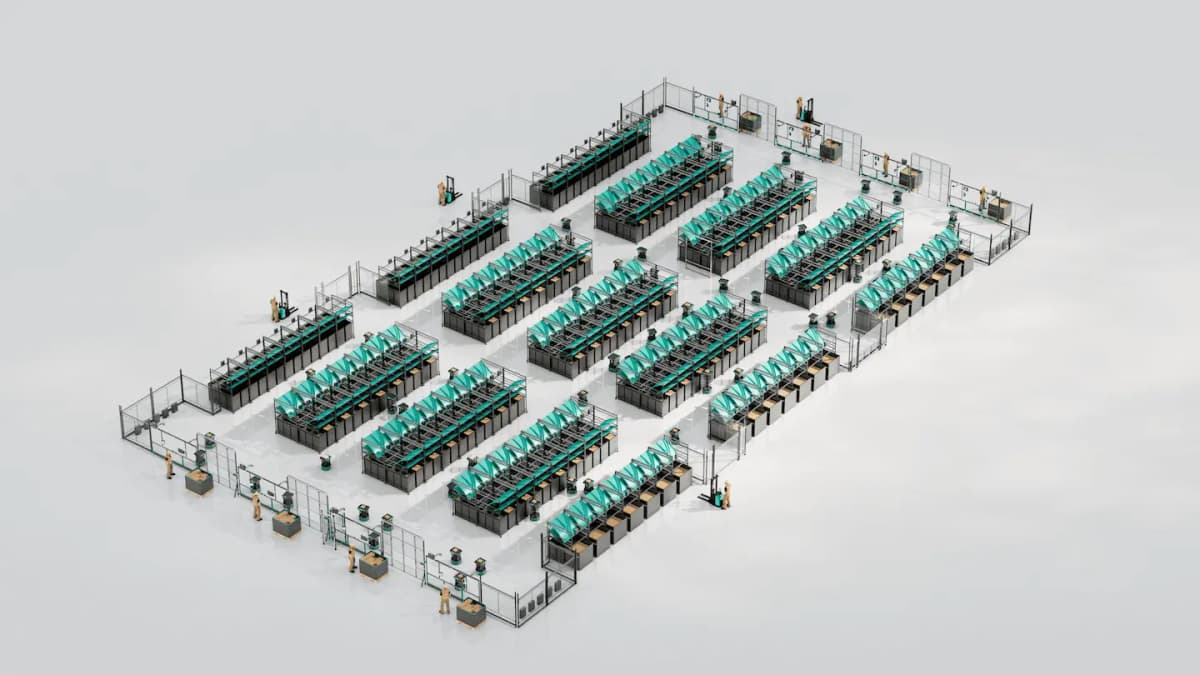
A customer needed to sort around 5,000 parcels per hour into approximately 2,000 delivery bags for parcel lockers and PUDO locations.
Several technologies could theoretically deliver the required throughput.
The real challenge wasn't speed.
It was space.
The building simply couldn't accommodate conventional alternatives.
Ultimately, the ability to fit the solution into the available footprint became the deciding factor.
This is something I see more and more often.
Warehouses aren't necessarily running out of throughput.
They're running out of square metres.
Every additional conveyor, staging area or manual sorting station consumes valuable space that could otherwise generate value.
The most successful automation projects today don't simply maximise throughput.
They maximise throughput per square metre.
Peak is the test. Preparation is the advantage.
Every warehouse has bottlenecks.
Peak season simply removes the buffer that normally hides them.
Whether it's labour shortages, inefficient sortation, limited floor space or outdated processes, these issues become expensive when volumes surge.
The good news is that none of them appear overnight.
The operators who consistently succeed during peak aren't necessarily the ones who spend the most on automation.
They're the ones who start early, challenge long-standing assumptions and design processes for the business they'll have three years from now - not the one they had three years ago.